
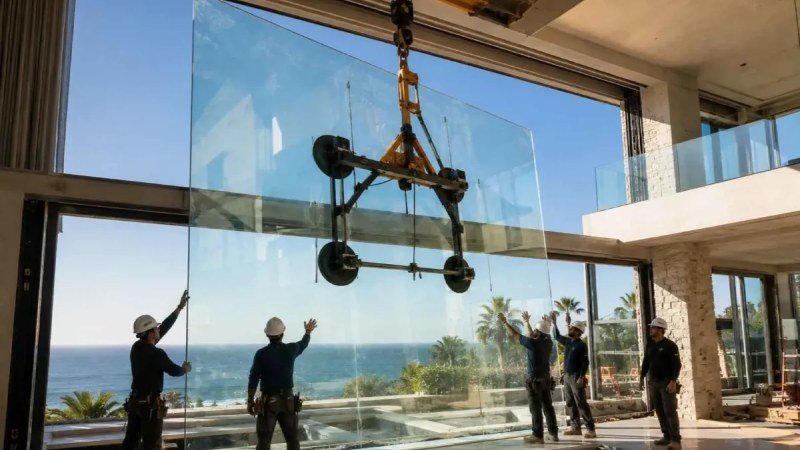
Walk past any major city skyline and you will notice something remarkable: glass is everywhere. From floor-to-ceiling curtain walls to sweeping structural facades, modern architecture has become almost synonymous with the reflective shimmer of enormous glass panels. But have you ever stopped to wonder how those massive sheets of glass, some weighing several tons, make their way from a factory floor to heights of hundreds of feet and end up positioned with millimeter precision? The answer involves a fascinating combination of engineering ingenuity, highly specialized rigging equipment, and a skilled workforce that treats every lift like a science.
It Starts Long Before the Glass Arrives
The installation of large-scale glazing on a building does not begin on the day the panels arrive on site. Weeks or even months of planning precede the first lift. Structural engineers, glazing contractors, and rigging specialists collaborate to produce a detailed lift plan that accounts for each panel’s weight and dimensions, wind conditions at various heights, the building’s structural load points, and the installation sequence.
Manufacturers do not make the glass panels used in modern commercial buildings from the thin, fragile sheets that most people imagine. Instead, they typically build insulated glass units (IGUs) by bonding two or three layers of tempered or laminated glass together around a hermetically sealed air or gas gap. A single panel on a skyscraper façade can measure 10 feet wide and 15 feet tall and weigh more than 2,000 pounds. When manufacturers include the aluminum framing, some unitized curtain wall panels weigh more than 4,000 pounds.
The Role of Rigging in Glass Installation
Getting a panel that size from a flatbed truck to its mounting position on the 30th floor requires purpose-built rigging equipment. This is where the trade’s true craftsmanship becomes apparent.
Vacuum Lifting Devices are among the most critical tools in a glazier’s arsenal. These units use powerful suction cups mounted on a spreader frame to grip the glass surface evenly across its full face, distributing the load without creating stress concentrations that could crack the panel. A typical vacuum lifter used in commercial glazing might carry eight to sixteen suction cups with a combined lift capacity of 5,000 pounds or more. An electric or pneumatic pump maintains the vacuum, and most professional-grade units feature dual-circuit redundancy so the backup circuit holds the load if one circuit fails, allowing operators to set the panel down safely.
Spreader beams are also essential for handling wide or irregularly shaped panels. A spreader beam is a rigid horizontal bar, often made of high-strength steel, that distributes lifting force across multiple pick points. By spreading the load, the beam prevents rigging slings from pulling inward at an angle that could damage the glass or the frame. For especially large curtain wall units, a customized spreader beam may be fabricated for a single project.
Chain hoists and electric chain blocks are often used with cranes for precise positioning. Once a tower crane brings the glass to roughly the correct elevation, a glazier working on a suspended scaffold or a motorized work platform will use a chain hoist attached to the building’s structure to nudge the panel into its exact final position. Chain hoists allow fine incremental adjustments and can safely hold a load while workers secure the mechanical fasteners or structural silicone connections.
Wire rope slings and round slings provide a flexible connection between a lifting device and the spreader beam or vacuum lifter. Wire rope slings offer durability and resistance to abrasion in harsh construction environments, while round slings, made from polyester fibers encased in a protective sleeve, are gentler on finished surfaces and preferred when contact with a coated or sensitive surface must be avoided.
The Lift Itself
On installation day, the sequence of events unfolds quickly but deliberately. Contractors position a tower crane or a specialized building maintenance unit equipped with a davit arm above the pick zone. Riggers attach the spreader beam to the crane hook with shackles and wire rope slings, confirming that every connection meets the required load rating and has passed inspection. They then attach the vacuum lifter to the spreader beam and position the suction cups on the glass panel while it still rests on protective dunnage on the ground.
Once technicians confirm that the vacuum has reached a safe operating pressure and perform a test lift of a few inches to verify a secure hold, the crane operator raises the panel smoothly. The crane operator deliberately keeps the lifting speed low to avoid dynamic loading, which can multiply the effective weight on the rigging.As the panel ascends, a guide rope, handled by a worker on the ground, prevents uncontrolled rotation.
At the installation level, workers on scaffolding or platforms guide the panel into place using tag lines and, when needed, a chain hoist or come-along for the final fine adjustment.Installers set the panel into its receiver channel or onto its mounting brackets, shim it until it is level, and temporarily secure it before releasing the vacuum. They then install the permanent mechanical fasteners and weatherproofing.
Special Challenges: Wind, Height, and Building Geometry
Glass installation on tall buildings introduces complications that ground-level work does not. Wind is the most significant factor. Even a modest breeze can exert enormous forces on a large, flat panel acting as a sail. Most glazing contractors set wind-speed thresholds, commonly 20 to 25 miles per hour at the installation level, above which lifts are paused. Anemometers mounted at height on the building continuously feed wind data to the site supervisor.
Some modern buildings feature curved or faceted facades, adding another layer of complexity. Manufacturers often create uniquely shaped panels for these structures and cannot interchange them, so if installers damage a panel during installation, they cannot simply replace it. Rigging teams working on curved facades often use customized vacuum lifter frames that they can adjust to match the precise angle of each panel’s face.
Safety Above Everything
Every piece of rigging equipment used in glass installation has a documented working load limit, and responsible contractors never exceed it. Before any lift, a toolbox talk reviews the lift plan, assigns roles to each team member, and confirms the communication protocol between the crane operator and the rigging crew. Hand signals and radio communication are used together to eliminate ambiguity at critical moments.
The combination of modern vacuum-lifting technology, precisely engineered spreader beams, reliable chain hoists, and carefully rated wire rope and round slings has made large-scale glazing installation far safer and more predictable than it was even two decades ago. The glass towers that define our cities are not just architectural statements. They are the product of meticulous planning, purpose-built equipment, and a skilled workforce that makes the extraordinary routine.