
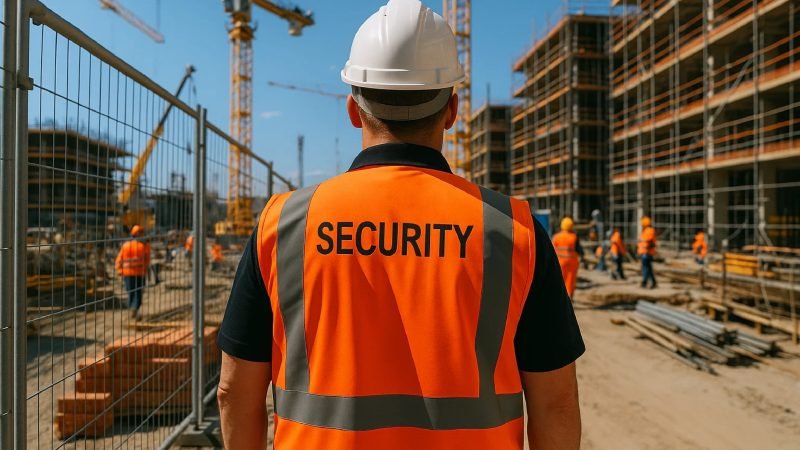
Introduction: Construction Sites Are Among the Most Vulnerable Workplaces in Australia
A construction site is, in many ways, one of the most exposed commercial environments that exists. Expensive equipment sits in the open. Materials worth tens of thousands of dollars are stored on-site for days or weeks at a time. Access points are numerous, and the rotating roster of workers, subcontractors, and delivery personnel makes it difficult to track who is on-site at any given moment.
The financial cost of this vulnerability is significant. According to industry data from the Master Builders Association, 89 percent of construction companies in Australia have experienced theft or vandalism in the past three years. Construction site theft costs the Australian building industry an estimated 1.5 billion dollars annually, and the knock-on effects, project delays, insurance premium increases, and workplace safety risks, compound that figure considerably.
The most effective response to this challenge is not a single measure but a comprehensive, layered approach. Professional construction site security services bring together physical presence, technology, access management, and safety compliance into one integrated solution that protects people, assets, and timelines simultaneously.
This article explains how that works in practice, and why construction companies that invest in professional security consistently achieve better outcomes across safety, compliance, and productivity.
Key Takeaways
- Construction site theft costs the Australian building industry an estimated 1.5 billion dollars annually
- 89 percent of Australian construction companies have experienced theft or vandalism in the past three years
- Theft-related project delays cost the industry an estimated 400 million dollars per year in Australia alone
- A layered security approach combining physical guards, mobile patrols, CCTV, and access control is the most effective deterrent
- Professional security supports WHS compliance, which reduces legal liability for site managers
- Well-secured sites experience fewer insurance claims and can access lower premium rates over time
The Real Cost of Inadequate Construction Site Security
Before examining what good security looks like, it is worth understanding exactly what poor security costs. The financial damage from construction site theft goes well beyond the replacement value of stolen items.
Victorian construction theft losses total approximately 380 million dollars annually, and theft-related project delays cost the Australian construction industry an estimated 400 million dollars per year. When equipment is stolen, projects stall. Subcontractors cannot work. Replacement procurement takes days or weeks for specialized items, and rescheduling creates coordination failures that cascade through the entire build program.
Industry analysis shows that the total cost of theft averages 2.5 to 3 times the value of the stolen items once teams account for all consequential losses. This means a single night’s theft of materials worth $10,000 can ultimately cost a project $25,000 to $30,000 when you include labor stoppages, replacement logistics, and insurance excess costs.
The damage is not purely financial either. Construction companies dealing with repeated theft face higher insurance premiums, potential policy cancellations, worker safety risks from tampered equipment and missing safety barriers, and legal liability under OH&S frameworks when unsecured sites are accessed by trespassers.
The conclusion is straightforward: the cost of professional security is almost always lower than the cost of not having it.
What a Complete Construction Site Security Solution Looks Like
Professional security for construction sites is not simply a matter of hiring a guard. A comprehensive solution draws on multiple complementary services, each addressing a different vulnerability in the site’s security profile.
Static Security Guards
On-site security officers provide a visible, immediate human presence that deters opportunistic theft, manages access, and responds to incidents in real time. Static guards positioned at entry and exit points perform several critical functions simultaneously:
- Checking the identity of workers, subcontractors, and visitors before granting site access
- Monitoring vehicle movements and logging deliveries
- Conducting regular perimeter and equipment compound checks throughout the shift
- Responding immediately to alarms, disturbances, or safety concerns
- Maintaining an incident log that supports insurance claims and incident investigations
A uniformed officer on site communicates clearly to anyone approaching that the site is actively monitored and protected. That visible deterrence alone reduces opportunistic theft significantly.
Mobile Patrols
Not every site requires a static guard on duty around the clock, but every site needs consistent monitoring outside of working hours. Mobile patrol services provide regular, unpredictable visits to a site during overnight and weekend periods, which is precisely when most construction theft occurs.
Darkness is a thief’s best friend, and construction sites without adequate after-hours monitoring provide cover for criminals to work undetected for extended periods. Mobile patrols interrupt that window of opportunity by creating uncertainty about when and how often security will attend. Because the timing of patrols is deliberately varied, potential thieves cannot simply wait for a predictable gap.
Mobile patrol officers check that perimeter fencing is secure, gates are locked, equipment compounds are intact, and alarm systems are functioning correctly. Any breach or anomaly triggers an immediate response.
Gatehouse Security
For larger construction projects, a dedicated gatehouse at the main vehicle entrance provides a central command point for access management. Gatehouse officers control the entry and exit of all vehicles, maintain records of who enters and leaves, and enforce site access protocols for workers, subcontractors, and visitors.
This level of access control is particularly important in addressing insider theft. A significant proportion of construction site losses involve workers, subcontractors, or delivery personnel with legitimate access to the site, and robust access control including signed visitor logs, contractor ID requirements, and vehicle entry protocols significantly reduces this risk.
Alarm Monitoring and Response
Electronic alarm systems form a critical layer of any construction site security strategy, but an alarm that triggers without a rapid human response provides limited protection. Professional security providers offer alarm monitoring and rapid response services, so when a sensor triggers, a security officer can arrive on-site within minutes instead of waiting for police.
Fast alarm response times are a significant deterrent. Organized theft groups that know a site has monitored alarms with rapid response capability will typically target less protected sites instead.
Electronic Security and CCTV
Closed-circuit television surveillance serves two distinct functions on a construction site. First, it acts as a visual deterrent. Cameras positioned at entry points, equipment compounds, and material storage areas communicate to anyone on site that their movements are being recorded. Second, it provides an evidentiary record that supports insurance claims, incident investigations, and, when necessary, prosecutions.
Modern CCTV systems integrated with alarm monitoring allow security providers to observe multiple points across a site remotely, supplement physical patrols, and respond to anomalies even before a guard on the ground identifies them.
How Security Services Support WHS Compliance on Construction Sites
Australia regulates construction as one of the most heavily controlled industries from a workplace health and safety perspective. The Work Health and Safety Act 2011 places clear obligations on principal contractors and site managers to maintain site safety and control access.
This is where professional security services play a role that extends beyond theft prevention. Security personnel trained in construction industry WHS requirements contribute to compliance in several practical ways:
- Enforcing personal protective equipment requirements at site entry points
- Controlling access to ensure that only inducted workers and authorized visitors enter the site
- Monitoring that safety exclusion zones around heavy machinery and elevated work areas are not breached
- Identifying and reporting hazards observed during patrols
- Maintaining records of site attendance that support emergency evacuations and incident investigations
When a construction site fails to control access or enforce safety protocols, it exposes itself to significant regulatory risks, including improvement notices, prohibition notices, and substantial fines under WHS legislation.Professional security teams reduce this exposure by consistently enforcing access protocols throughout the project’s duration.
The Productivity Case for Professional Security
The connection between site security and project productivity is not always obvious, but it is real and well documented.
When workers arrive in the morning to find equipment missing, materials stolen, or perimeter fencing breached, productive work stops immediately. Replacement equipment must be sourced, insurance assessors must be contacted, police reports must be filed, and the project timeline must be renegotiated. Everyone on site loses time they cannot recover.
Beyond direct theft incidents, a poorly secured site creates a low-level environment of concern that affects worker focus and morale. Workers who are uncertain whether their personal tools or vehicles are safe while they are on site are less productive than workers who feel secure.
A well-secured site with professional personnel, clear access protocols, and consistent monitoring creates a work environment where tradespeople can focus entirely on their work. The financial and operational stability that comes from knowing your site is protected reduces the administrative burden on site managers and allows the project to proceed on schedule.
A Case Study: What Integrated Security Delivers in Practice
An infrastructure contractor managing a large-scale residential development project in New South Wales implemented a comprehensive security program comprising static guards, mobile patrols, gatehouse management, and CCTV monitoring after experiencing two separate theft incidents in the project’s first two months.
Over the following eight months, the site recorded zero theft incidents. At renewal, the insurance broker reviewed the project’s risk profile, recognized the security investment, and maintained the premium at the previous rate instead of applying the anticipated increase.
More significantly, the team completed the project two weeks ahead of the revised schedule that had accounted for delays caused by the initial thefts. The site manager attributed part of this recovery to the confidence workers had in the site’s security infrastructure, which enabled them to stage materials more efficiently and deploy equipment without the conservative overstocking previously required to offset potential losses.
Choosing the Right Security Provider for Your Construction Site
Not all security providers have the same understanding of construction industry requirements. When evaluating options, consider the following:
- Does the provider have specific experience with construction site environments, including familiarity with WHS obligations and the particular challenges of below-grade work, elevated work, and heavy plant management?
- Are their officers licensed under the relevant state security licensing framework?
- Can the provider offer an integrated solution that combines static guarding, mobile patrols, alarm response, and electronic security?
- Do they offer flexible service configurations that can scale with the project as it moves through different phases?
- Can they provide detailed incident reporting and regular security reviews?
A provider that can answer yes to all of these questions is in a position to become a genuine safety partner for the duration of your project rather than simply a line item in the project budget.
Frequently Asked Questions
What types of security services are typically used on construction sites?
A comprehensive construction site security solution typically combines static security guards at access points, mobile patrol officers for after-hours monitoring, gatehouse management for vehicle and visitor control, alarm monitoring and rapid response services, and CCTV surveillance. The appropriate combination depends on the size of the site, the value of materials and equipment on-site, the project’s duration, and the specific risk profile of the location.
How much does construction site theft actually cost Australian businesses?
According to industry data, construction site theft costs the Australian building industry approximately 1.5 billion dollars annually. The Master Builders Association reports that 89 percent of Australian construction companies have experienced theft or vandalism in the past three years. Beyond direct replacement costs, total theft impact costs average 2.5 to 3 times the value of stolen items when project delays, labor stoppages, and insurance implications are factored in.
Does having professional security on a construction site reduce insurance costs?
Yes, in most cases. Insurance providers assess construction sites as higher or lower risk based on the security measures in place. Sites with documented professional security arrangements, including licensed guards, alarm monitoring, and CCTV, typically qualify for more favorable premium assessments than unprotected sites. Equally important, fewer incidents mean fewer claims, which protects the site’s claims history over time. The BauWatch 2024 Construction Crime Index shows that CCTV adoption in Australia has reduced theft rates by 50 percent at monitored sites.
Can construction site security services help with WHS compliance?
Yes. Professional security personnel trained in construction industry requirements contribute to WHS compliance by enforcing PPE requirements at site entry, controlling access to ensure only inducted workers and authorized visitors enter, monitoring safety exclusion zones, and maintaining attendance records that support emergency evacuation procedures and incident investigations. This reduces the regulatory risk for principal contractors and site managers under the Work Health and Safety Act 2011.
At what stage of a construction project should security services begin?
Security should be in place from the moment materials and equipment first arrive on site, which in practice means before construction begins. The period before a site is fully operational is often the highest-risk window, because perimeter infrastructure may not yet be complete and the site has not yet established a regular workforce presence that provides natural deterrence. Many experienced contractors arrange security coverage from the day the hoarding goes up.
Conclusion: Security Is a Project Investment, Not an Overhead
Construction companies most commonly delay investing in professional security because they view it as a cost without a direct return. However, the data shows a different reality. When you properly account for the full financial impact of theft, project delays, insurance consequences, and regulatory risk, professional security services consistently deliver measurable value.
A secured construction site improves safety, compliance, and productivity. Workers focus on their tasks, teams deploy materials and equipment efficiently without excessive contingencies, and projects stay on schedule and within budget.
When the project concludes, the site’s security record also strengthens the contractor’s reputation and supports future tenders.
Construction site security does not function as an overhead to minimize—it operates as a project investment with clear, quantifiable returns.