

For architecture and spatial design students, the final year of university brings a unique and often overwhelming challenge. Unlike standard humanities or science majors who focus entirely on written arguments or laboratory data, design students must live in two worlds at once. You are expected to be a brilliant creative visionary in the design studio, producing breathtaking 3D renders and detailed blueprints. At the same time, you must act as a rigorous academic researcher, compiling a massive, theoretically sound dissertation that satisfies strict university guidelines.
This dual expectation creates an intense bottleneck. When the pressure of studio deadlines collides with the meticulous demands of academic writing, balancing the workload can feel nearly impossible. Translating complex spatial ideas into a structured, formal paper requires an entirely different cognitive skillset than sketching a site plan. If formatting guidelines, empirical data analysis, or dense theoretical frameworks start to stall your progress, turning to external expertise can change everything. Thousands of university students regularly look to reliable academic consulting services to safely do my thesis papers, allowing professional academic writers from MyAssignmentHelp to handle the heavy linguistic lifting while the students focus on refining their physical design portfolios.
The Foundation: Bridging Spatial Design and Academic Theory
Every great building requires a deep, stable foundation before any visible structure can rise from the ground. Your architecture dissertation works exactly the same way. The biggest mistake undergraduate students make is treating their design project and their written dissertation as two separate entities. In a high-scoring final year project, your design is the realization of your theory, and your theory is the justification for your design.
To bridge this gap smoothly, you must establish a clear theoretical framework early on. Are you examining your project through the lens of Phenomenology (how humans sensorially experience a space)? Are you analyzing it via Parametricism (using computational algorithms to dictate form)? Or perhaps your focus is purely on Biophilic Design (integrating natural systems into urban environments)? Whichever route you choose, your written text must explicitly define these concepts and explain how they directly influence the walls, windows, materials, and layouts of your physical models.
Navigating the Literature Review Without Losing Your Way
A literature review is not just a chronological list of books you have read. It is an analytical map of the existing conversations surrounding your chosen topic. For an architecture student, this means evaluating historical design movements, spatial theories, zoning laws, and contemporary case studies to find a “gap” that your specific project will fill.
When managing a vast library of sources, organization is your primary defense against chaos. It is highly recommended to use a synthesis matrix to group your reading material by theme rather than by author. For instance, if your topic is sustainable urban renewal, group your sources into categories like “Economic Impact,” “Material Lifespans,” and “Community Psychology.” This structured approach keeps your writing fluid, scannable, and logically sound.
| Architectural Research Component | Primary Objective | Common Undergraduate Pitfall |
| Theoretical Framework | Establishes the philosophical lens of your spatial design. | Selecting a theory that has zero impact on the actual physical project. |
| Literature Review | Evaluates existing academic consensus and historical precedents. | Writing a simple summary of books instead of critically analyzing them. |
| Methodology | Outlines how data (spatial, environmental, qualitative) is gathered. | Failing to explain why a specific case study or simulation tool was chosen. |
| Data Analysis | Synthesizes technical metrics with spatial design outcomes. | Presenting raw data charts without explaining their design implications. |
Methodology: How Architects Gather and Apply Data
How do architects conduct research? Unlike a traditional scientist in a white coat, an architectural researcher relies on a diverse, mixed-methods approach. Your methodology chapter must clearly explain the specific tools and strategies you used to gather your research insights.
For undergraduate dissertations, architectural research data generally falls into three distinct categories:
- Quantitative Environmental Metrics: This involves concrete, numerical data such as solar radiation maps, thermal performance calculations, structural load limits, and acoustic simulations.
- Qualitative Spatial Analysis: This focuses on the human element, utilizing user interviews, post-occupancy evaluations, historical text analysis, and direct observational mapping of how people move through a specific public space.
- Comparative Case Studies: A deep architectural analysis of existing buildings that share similarities with your proposed project, breaking down their structural successes and functional failures.
By clearly defining these methods, you demonstrate to your university examiners that your design choices are grounded in objective reality and academic fact, rather than just personal aesthetic preference.
Synthesizing Complex Data into Clean Academic Writing
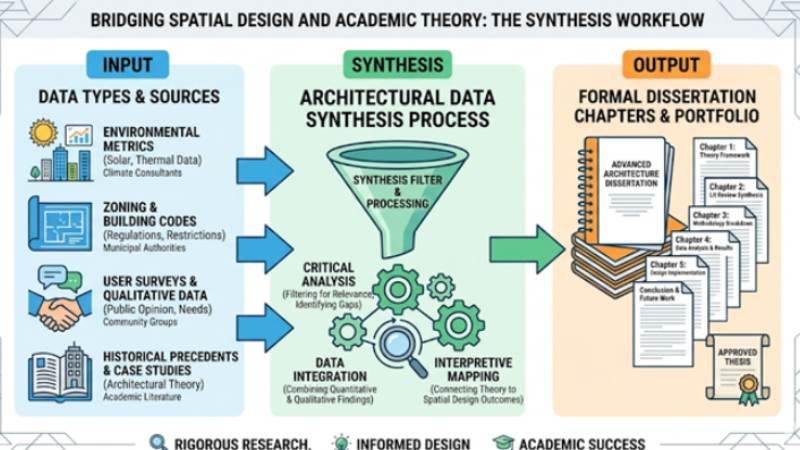
Once you have gathered your environmental simulations, zoning data, and historical research, the ultimate challenge begins: translating those findings into clear prose. This is where many passionate designers encounter a massive roadblock. It is incredibly frustrating to have a brilliant, innovative spatial concept in your mind but struggle to articulate it within the rigid boundaries of formal academic language.
+————————————————————-+
| THE DISSERTATION WORKFLOW |
+————————————————————-+
[Phase 1: Theoretical Foundation] |
| Define your spatial philosophy & core research questions. |
+————————————————————-+
|
v
+————————————————————-+
[Phase 2: Data & Context Gathering] |
Collect site metrics, zoning laws, and historic precedents. |
+————————————————————-+
|
v
+————————————————————-+
[Phase 3: Synthesis & Structural Writing]
Translate spatial data into formal academic chapters.
+————————————————————-+
When you find yourself completely overwhelmed by the sheer volume of chapters, citations, and structural requirements, remember that you do not have to carry the entire academic burden entirely on your own shoulders. Seeking specialized help can save your sanity and protect your GPA.
5. Structuring Your Final Chapters for High Marks
As you approach the final stretch of your paper, your focus must shift toward structural clarity and professional presentation. Your final chapters should synthesize your research findings with your ultimate design proposal.
Your conclusion chapter should never simply repeat what you have already written. Instead, use it to state the broader impacts of your work. How does your research change the way we think about urban spaces? What are the real-world limitations of your design? By answering these macro-level questions, you leave your university reviewers with a powerful impression of your critical thinking and academic maturity.
Frequently Asked Questions (FAQ)
Q.1 How long should an undergraduate architecture dissertation be?
Ans: While word counts vary depending on your specific university guidelines, a typical undergraduate architecture dissertation ranges between 8,000 and 12,000 words. If your project is heavily design-focused, the written requirement may be shorter to balance out your extensive studio portfolio.
Q.2 Can I use personal opinions in my architecture thesis?
Ans: In formal academic writing, personal opinions must always be backed up by empirical data, peer-reviewed literature, or established historical precedents. Instead of writing “I feel this space is welcoming,” write “Based on William Whyte’s theories of urban plazas, the spatial configuration encourages prolonged social interaction.”
Q.3 What referencing style is most common in architectural research?
Ans: Harvard and APA referencing are the most common styles used within architecture departments globally. However, some historical preservation programs prefer Chicago style footnotes. Always consult your university’s specific handbook before formatting your bibliography.
Q.4 How do I balance my studio time with my dissertation writing?
Ans: The most effective strategy is to treat your dissertation as an extension of your studio work rather than a separate chore. Dedicate fixed blocks of time early in the week solely to writing, and use your research findings directly to justify the design choices you make on your drafting board.
About The Author
Hello! My name is Thomas Taylor, and I am a senior academic consultant and research strategist with MyAssignmentHelp. With over a decade of experience guiding undergraduate and postgraduate students through complex STEM and design dissertations, I specialize in bridging the gap between rigorous research methodologies and creative execution.